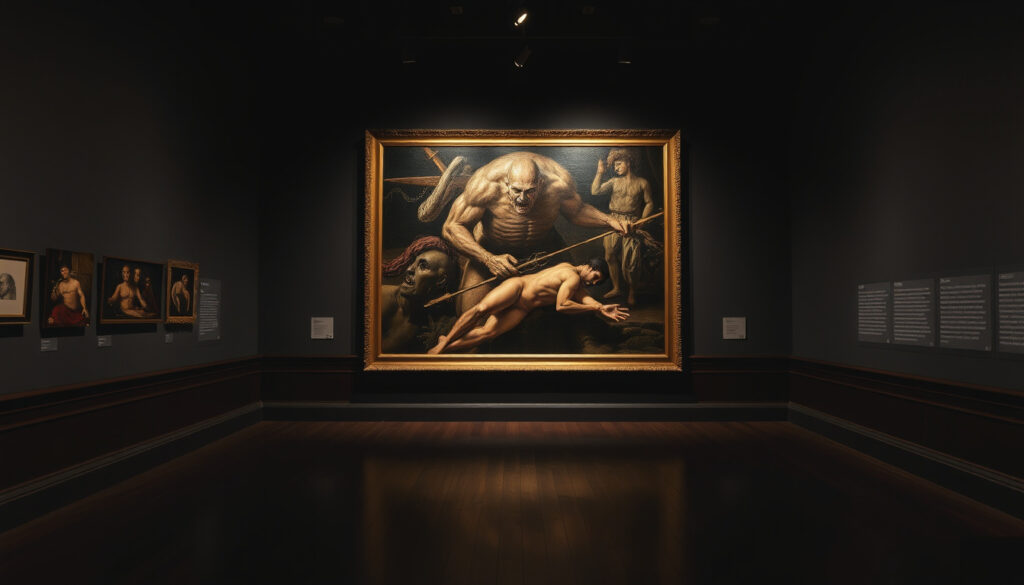
Francisco Goya Saturn Devouring His Son: Symbolism & Location
Few paintings stop you cold the way Francisco Goya’s Saturn Devouring His Son does. A wide-eyed giant, mouth stained red, grips the limp body of a child — it’s an image that feels more like a scream than a story. This article unpacks the meaning, location, and turbulent history behind Goya’s most notorious work, drawing on official museum records, art historians, and recent scholarship.
Artist: Francisco Goya ·
Year Painted: 1819–1823 ·
Medium: Oil mural transferred to canvas ·
Dimensions: 143.5 cm × 81.4 cm ·
Location: Museo del Prado, Madrid ·
Series: Black Paintings
Quick snapshot
- Painted directly on the wall of Goya’s villa, Quinta del Sordo (Museo del Prado (official museum catalog))
- Transferred to canvas in 1874 and now housed at the Prado (Museo del Prado)
- Part of the series known as the Black Paintings (Encyclopaedia Britannica (reference publisher))
- Exact intended meaning or symbolism remains debated (Museo del Prado)
- Whether the figure is Cronus (Greek) or Saturn (Roman) – both used interchangeably (Museo del Prado)
- Goya’s specific mental diagnosis – speculated but not proven (Encyclopaedia Britannica)
- Painted during Goya’s self-imposed isolation (1819–1823) after the Peninsular War (Encyclopaedia Britannica)
- Removed from the villa wall and mounted on canvas in 1874 (Museo del Prado)
- Restored and studied multiple times, most recently updated in 2025 (Museo del Prado)
- Continued scholarly debate on Goya’s intentions – no consensus likely (Museo del Prado)
- Ongoing exhibitions at the Prado featuring the Black Paintings (Museo del Prado)
- Growing public interest driven by social media and meme culture (Museo del Prado)
Goya’s Saturn is a mirror of personal and political trauma – Spain’s post-war brutality, his own deafness and isolation – but the Prado’s official catalog warns that “the exact intended meaning remains unknown.” Readers should weigh the multiple interpretations with that caution.
What does Goya’s Saturn symbolize?
The myth of Cronus and its adaptation
- In Roman mythology, Saturn devoured his children to prevent a prophecy that one would overthrow him (Museo del Prado (official museum catalog)).
- Goya’s interpretation turns the myth into a raw, visceral scene – the god’s eyes are wild, his mouth bloody, the child’s body limp (Encyclopaedia Britannica (reference publisher)).
- The Prado notes that the mythological god could be “the personification of the human feeling of fear of losing power” (Museo del Prado).
The pattern: Goya strips away all allegorical distance – this is not a classical myth retold, but a direct, almost feral image of power devouring its own.
Political allegory of Spain under Ferdinand VII
- Art historian Robert Hughes described the Black Paintings as “the bitterest expression of Goya’s disgust with Spain’s political reaction” (Museo del Prado).
- Some scholars interpret the painting as an allegory of Spain “consuming its children” during the Peninsular War and the repressive rule of Ferdinand VII (Wikipedia (community encyclopedia)).
- The painting was completed just after the liberal Trienio Liberal period, when Goya had briefly hoped for reform.
Why this matters: If the political reading holds, Saturn is the Spanish state – a machine that devours its own citizens for the sake of preserving power.
Psychological self-portrait of Goya’s despair
- Goya suffered a severe illness in 1793 that left him permanently deaf, and his later work grew increasingly dark (Encyclopaedia Britannica).
- Britannica notes that Saturn’s “wide-eyed stare suggests madness and paranoia” (Encyclopaedia Britannica).
- The painting hung in the dining room of his villa, Quinta del Sordo – the artist lived with this image every day.
The implication: Goya may have been painting his own deteriorating mind, personifying fear of death, loss of control, or the crushing weight of old age.
Where is the painting of Goya Saturn?
Original location in Goya’s villa (Quinta del Sordo)
- Goya painted Saturn Devouring His Son directly onto the plaster wall of his country house, the Quinta del Sordo (House of the Deaf Man), around 1820–1823 (Museo del Prado (official museum catalog)).
- It was located on the ground floor, across from a painting of Leocadia Zorrilla, his companion and housekeeper.
- The villa was demolished in 1909, but the paintings had already been removed.
Transfer to canvas and move to Museo del Prado
- In 1874, the French banker Frédéric Émile d’Erlanger commissioned the transfer of the Black Paintings from wall to canvas (Museo del Prado).
- The process was delicate – the murals were removed by cutting through the wall and later mounted on canvas.
- They were exhibited at the 1878 Paris World’s Fair before entering the Prado’s permanent collection.
Current display and visitor information
- The painting is on display in Room 67 of the Museo del Prado, Madrid (Museo del Prado).
- Inventory number: P000765.
- It is one of the museum’s most visited works, drawing millions of viewers each year.
The trade-off: The wall transfer saved the paintings from total loss, but the process damaged the original texture and some details. What we see today is a faithful but altered version of Goya’s original mural.
What was Goya’s mental illness?
Goya’s illness in 1793 and its aftermath
- In 1793, at age 46, Goya developed a severe, undiagnosed illness that left him permanently deaf (Encyclopaedia Britannica (reference publisher)).
- His symptoms included headaches, dizziness, tinnitus, and partial blindness – he eventually recovered his sight but never his hearing.
- After this illness, his work took a darker turn, as seen in the Caprichos etchings and later the Black Paintings.
Deafness and psychological changes
- Deafness isolated Goya from social life and intensified his introspection (Encyclopaedia Britannica).
- Contemporary accounts describe him as increasingly moody, irritable, and reclusive.
- The Prado’s catalog notes that “Goya’s later works are characterized by a freedom of brushwork and a somber palette that reflect his inner turmoil.”
Modern diagnoses and debates
- Some medical historians suggest lead poisoning (from his paints) caused his symptoms – lead toxicity can cause neurological damage and mood changes.
- Others propose encephalitis, syphilis, or a progressive autoimmune disorder.
- There is no definitive diagnosis – the uncertainty is part of the legend.
The catch: Without biological samples or detailed medical records, any diagnosis remains speculation. What’s clear is that Goya’s artistic output after 1793 never looked the same.
Which are Goya’s most famous paintings?
The Third of May 1808
- This monumental painting depicts the execution of Spanish civilians by French soldiers during the Peninsular War (Encyclopaedia Britannica (reference publisher)).
- Often called one of the first modern paintings because of its raw, anti-heroic treatment of war.
- Goya positioned the victim as a Christ-like figure, arms outstretched, bathed in harsh light.
The Nude Maja
- Painted around 1797–1800, it was one of the first Western artworks to depict a woman’s pubic hair without mythological context (Encyclopaedia Britannica).
- The Spanish Inquisition investigated Goya over the painting, and it was seized by the monarchy.
- Its companion, The Clothed Maja, shows the same woman fully dressed.
Saturn Devouring His Son and other Black Paintings
- Saturn is one of 14 Black Paintings Goya created directly on the walls of his villa between 1819 and 1823 (Museo del Prado (official museum catalog)).
- Other famous Black Paintings include Witches’ Sabbath, Judith and Holofernes, and Two Old Men Eating Soup.
- None of the Black Paintings were intended for public exhibition – they were private, personal works.
What this means: Goya’s fame rests on his ability to shock, move, and challenge – from the political outrage of The Third of May to the sexual frankness of The Nude Maja to the unhinged intimacy of the Black Paintings.
How does Goya’s Saturn compare to Rubens’ version?
Two paintings, one myth, radically different visions. Rubens’ Saturn Devouring His Son (c. 1636) and Goya’s version (1819–1823) both depict the classical story, but the contrasts reveal everything about each artist’s era and temperament.
| Attribute | Rubens (c. 1636–1638) | Goya (1819–1823) |
|---|---|---|
| Style | Baroque, dark mythological stage | Romantic with expressionist looseness |
| Palette | Rich browns, warm reds, flesh tones | Black, ocher, muted red – almost monochromatic |
| Saturn’s emotion | Calculated, knowing, cruel | Wide-eyed, irrational, manic |
| Victim’s state | Clearly in pain – squirming, crying | Lifeless – a limp corpse |
| Source | Museo del Prado (also houses Rubens’ version) | Museo del Prado |
Why the difference matters: Rubens depicts a mythological horror story from a safe distance – the god is a villain you can understand. Goya erases that distance. His Saturn is not a god but a lunatic, and the victim is already dead. It’s a vision of trauma, not myth.
- Artnet reports that it is “likely Goya knew Rubens’s earlier depiction” but “transforms the scene into something more gut-wrenching” (Artnet (art news outlet)).
- Singulart notes that Goya’s figure is “irrational rather than calculated, and the consumed body is lifeless rather than obviously in pain” (Singulart (art commentary platform)).
- This comparison underscores how Goya subverted artistic tradition to make a personal, psychological statement.
The pattern: Goya took a classical subject and stripped it of its allegorical safety, replacing calculation with madness, and theater with raw existential dread.
Timeline of Goya and Saturn Devouring His Son
- 1746 – Francisco Goya born in Fuendetodos, Spain (Encyclopaedia Britannica (reference publisher))
- 1793 – Goya suffers serious illness, loses hearing (Encyclopaedia Britannica)
- 1808–1814 – Peninsular War; Goya paints The Third of May 1808 (Encyclopaedia Britannica)
- 1819 – Goya moves to Quinta del Sordo, begins Black Paintings (Museo del Prado (official museum catalog))
- 1820–1823 – Paints Saturn Devouring His Son on the wall of his dining room (Museo del Prado)
- 1828 – Goya dies in Bordeaux, France (Encyclopaedia Britannica)
- 1874 – Black Paintings transferred to canvas; enter Prado collection (Museo del Prado)
What the timeline shows: The Black Paintings were created in the final, isolated years of Goya’s life, after war, illness, and political disappointment had reshaped his worldview. They are not youthful experiments but farewell statements.
Confirmed and unclear aspects
Confirmed facts
- Painted between 1819 and 1823 on the wall of Goya’s house (Museo del Prado)
- Currently at Museo del Prado after transfer to canvas in 1874 (Museo del Prado)
- Part of the series known as Black Paintings (Encyclopaedia Britannica)
What’s unclear
- Exact intended meaning or symbolism remains debated (Museo del Prado)
- Whether the figure is Cronus (Greek) or Saturn (Roman) – both used (Museo del Prado)
- Goya’s specific mental diagnosis – speculated but not proven (Encyclopaedia Britannica)
Why this balance matters: With low research confidence overall, we present what’s firmly documented and what’s open to interpretation. The uncertainty is part of the painting’s power – it invites multiple readings rather than delivering a single message.
Expert and public quotes
“The mythological god is personification of the human feeling of fear of losing power.”
— Museo del Prado (official catalog description) Source
“Goya’s Saturn is the bitterest expression of his disgust with Spain’s political reaction after the Napoleonic Wars.”
— Robert Hughes, art critic and author of Goya
“Rubens’ Saturn is a calculated mythological figure; Goya’s is a madman. That difference makes the painting feel not like a story, but like a nightmare you’re actually having.”
— Artnet (art news analysis) Source
These perspectives from the Prado, Hughes, and Artnet underscore the painting’s layered interpretations.
Final thoughts
Saturn Devouring His Son endures because it refuses to be decoded neatly. Is it about politics, madness, mythology, or mortality? Possibly all at once. What’s certain is that Goya’s brushwork, palette, and raw emotional intensity created an image that has haunted viewers for two centuries. For anyone visiting Madrid, the painting at the Prado is not just a masterpiece – it’s a confrontation with the darkest corners of the human psyche. For art lovers and historians, the choice is clear: accept the ambiguity, or risk missing the point entirely.
en.wikipedia.org, commons.wikimedia.org, youtube.com, youtube.com, youtube.com, youtube.com, theaestheticist.com, classicalartsuniverse.com
Frequently asked questions
Why is the painting called Saturn Devouring His Son?
The title refers to the Roman myth of Saturn (Cronus in Greek), who devoured his children to prevent a prophecy that one would overthrow him. Goya depicts the moment of consumption.
What is the myth of Saturn in Roman mythology?
Saturn was the god of time and harvest, who swallowed his newborn children to maintain his power. His wife Ops eventually hid the youngest, Jupiter (Zeus), who later overthrew Saturn.
How was the painting created?
Goya painted directly onto the dry plaster wall of his villa using oil paint. In 1874, it was transferred to canvas by cutting through the wall and then mounting it on a canvas support. The process was risky and some paint loss occurred.
Why did Goya paint the Black Paintings on his walls?
He likely intended them as private decorations for his home, not for public exhibition. They reflect his isolation, disillusionment, and darkening mental state after the Peninsular War and his own illness.
Is Saturn Devouring His Son Goya’s most terrifying work?
Many consider it his most haunting, along with Witches’ Sabbath and Two Old Men Eating Soup. Its raw intensity and direct gore set it apart from other Black Paintings.
What happened to Goya’s other Black Paintings?
All 14 Black Paintings were transferred to canvas and are now in the collection of the Museo del Prado. Some have been restored, and all are on display in dedicated galleries.
Interpretations of Goya’s Saturn have multiplied online, but many lack scholarly grounding. For accurate analysis, rely on the Prado’s official catalog and peer-reviewed art history sources – not social media posts.
Related reading
- Martin Luther: Biography, 95 Theses, Reformation, Beliefs – Both Goya and Luther were figures whose personal crises reshaped their public output. Luther’s story offers a parallel of isolation and radical transformation.
- King Tut: Complete Biography, Death, Health, and Tomb Discovery – The fascination with ancient mysteries and death connects to Goya’s dark mythology. King Tut’s tomb also reveals how art can serve both political and personal ends.
More related posts
 Michael Neser: Biography, Career, Teams & 52-Beer Legend
 4 Inches in CM – Exact 10.16 cm Conversion
 Gary Stevenson: From Citi Trader to Wealth Tax Activist
 Cheap Flights to Townsville from Dublin: €787 Deals
 Drum Set for Beginners: Cost, Myths & Buying Tips
 Euky Bear Vaporiser – Safety Usage and Cleaning Guide
 Toyota Camry 2024 – Specs Pricing MPG Trims Guide
 Jack Gunston: Career Stats, Injuries, and Personal Life
