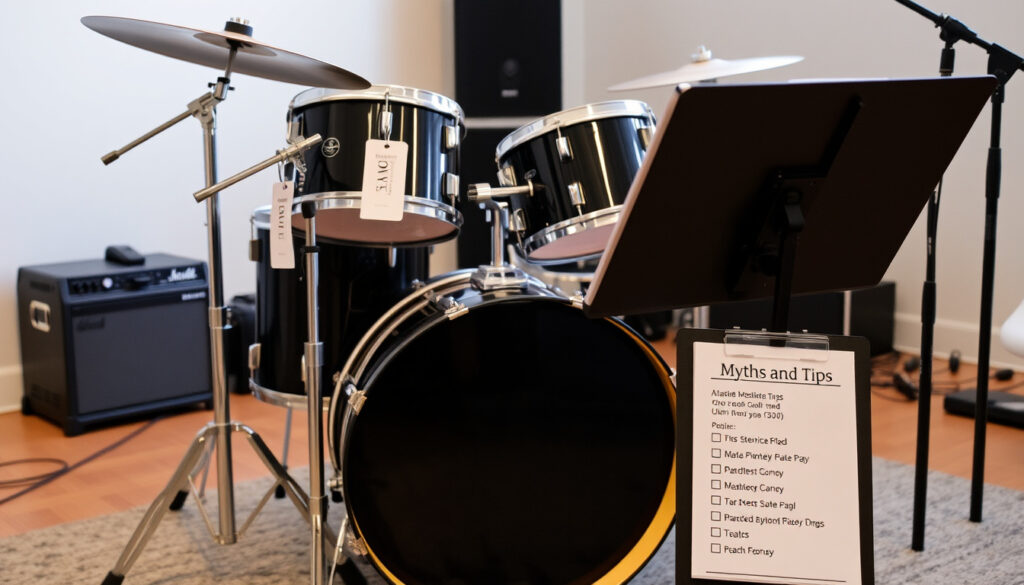
Drum Set for Beginners: Cost, Myths & Buying Tips
You’ve probably landed on a wall of price tags when searching for a beginner drum set. The real challenge isn’t finding a kit — it’s knowing what to prioritise. Verified prices from Irish music stores and expert teaching resources cut through the confusion, so you can start playing with confidence.
Average cost of a beginner drum set: $300–$600 ·
Typical cost of an intermediate drum set: $700–$1,500 ·
Percentage of drummers who start after age 16: estimated 40% ·
Common beginner drum kit configuration: 5-piece (bass, snare, 3 toms)
Quick snapshot
- Beginner drum sets cost between $300 and $600 on average (MusicRadar).
- No upper age limit exists for learning drums (School of Rock).
- Proper technique can reduce the risk of drummer’s syndrome (Roland).
- Exact percentage of late-starting drummers who turn professional is not well-documented.
- Long-term effectiveness of specific practice methods for adult beginners lacks large-scale studies.
- Adult beginners typically see noticeable progress within 3 months of structured practice (School of Rock).
| Label | Value |
|---|---|
| Average beginner drum set price | $300–$600 |
| Most common beginner configuration | 5-piece drum kit |
| Percentage of drummers who are adults starting later | estimated 40% |
| Recommended practice time per day for beginners | 15–30 minutes |
How much does a good drum set cost?
Price largely determines what you get in terms of build quality, sound, and durability. The pattern is clear: spending more early often saves you from upgrading later.
Entry-level drum kits ($300–$600)
- In Ireland, entry-level acoustic kits start at about €199 for a junior 5-piece set from stores like Trax Music Store.
- DXP JB1910 series kits sell for around €349, while the Hayman HM100 Start Series is priced at €459 (Trax Music Store).
- Electronic beginner kits start around $300–$500 according to MusicRadar; the Alesis Turbo Mesh is a popular value option at about $299.
The pattern: the lowest price tags often skip cymbals and hardware, so the real cost is higher once you add those – School of Rock warns always to check what’s included in a bundle.
The implication: a $300 drum set is a real starting point, but expect to spend another $100–$200 on sticks, stool, and headphones.
Mid-range drum kits ($700–$1,500)
- Intermediate acoustic kits in this range offer better shells, hardware, and sound quality. Gear4music Ireland stocks several options at this tier.
- The Roland entry-level V-Drums package (around $660/£420) features a dual-ply mesh snare and studio-quality sounds, ideal for home practice (MusicRadar).
- Up to about $800, you get better mesh heads, more realistic feel, and more sounds (MusicRadar).
The catch: if you can stretch to $700, the upgrade in playability and sound is dramatic – it’s the sweet spot for a committed beginner.
Professional drum kits ($2,000+)
- High-end kits from brands like Pearl, Yamaha, and DW are built for studio and stage use. Savins and Musicmaker Dublin carry professional lines.
- Most beginners don’t need this tier, but it’s worth knowing the ceiling if you plan to stick with drumming long-term.
How much should a beginner spend on a drum set?
A beginner budget must balance affordability against quality that won’t hinder progress. The evidence points to a clear range.
Budget recommendations for new drummers
- School of Rock advises spending $400–$700 for a reliable starter kit that won’t frustrate you with poor tuning or broken parts.
- In Ireland, that translates to roughly €350–€650 based on Trax Music Store and Gear4music Ireland listings.
- The Music Rooms says beginner spending can range from a few hundred pounds to a few thousand – but the sweet spot for value is the lower mid-range.
Hidden costs: hardware, cymbals, and accessories
- Bundles often include only the drums – cymbals, stands, throne, and sticks are extra. School of Rock specifically recommends looking for bundled hardware and cymbal sets because they cost less than buying separately.
- Drumsticks and practice pads add about £60 to the initial outlay (The Music Rooms).
- Don’t forget a sturdy throne (stool) – a wobbly seat kills practice.
The catch: a $400 kit can easily become a $600 purchase once you add essentials. Budget 30% extra on top of the kit price.
Should you buy used or new?
- Melodics recommends considering used kits for significant savings – often 30–50% below retail.
- Inspect used kits for cracks, rusted hardware, and missing tension rods (Melodics).
- Private sellers on DoneDeal or Adverts.ie in Ireland can be good sources, but Savins and Musicmaker also offer new kits with warranty.
The pattern: a well-maintained used kit gives you more kit for the same money – a €300 used kit can be equivalent to a €500 new one.
What is the best drum kit for beginners?
The answer depends on your living situation and practice goals. Choosing between acoustic and electronic is the first major fork in the road.
Acoustic vs. electronic for beginners
- Acoustic drums produce authentic sound and are typically cheaper for the same tier, but they’re loud – not ideal for apartments (Roland).
- Electronic kits allow silent practice via headphones and include built-in sounds and metronomes. Gear4music Ireland has a dedicated beginner electronic category.
- Hybrid kits (acoustic drums with electronic triggers) exist but are advanced territory.
The trade-off: if you live in a shared house, an electronic kit is the only realistic option for regular practice.
Top beginner brands: Pearl, Yamaha, Ludwig
- Pearl Export and Yamaha Stage Custom are legendary beginner/intermediate kits that hold resale value.
- Ludwig makes affordable entry-level kits (Trax Music Store carries Ludwig models).
- For electronic, Roland V-Drums (TD-07KV) and Yamaha DTX402K are often recommended by MusicRadar.
Features to look for in a beginner kit
- 5-piece configuration (bass, snare, floor tom, two mounted toms) is standard and versatile (School of Rock).
- Look for double-braced hardware for stability.
- A mesh head snare on electronic kits dramatically improves feel (MusicRadar).
The implication: a 5-piece Pearl or Yamaha acoustic kit, or a Roland TD-07KV electronic kit, gives you a foundation you won’t outgrow quickly.
A beginner buying their first kit should spend $400–$700 and prioritise a 5-piece acoustic or a Roland/Yamaha electronic kit. Those who go cheaper than $300 often end up upgrading within a year.
Is 16 too late to start drums?
Age is the most common worry for new drummers, but the evidence dismisses it. Starting at 16 – or 60 – does not close the door to skill.
Research on starting age and skill development
- No credible evidence shows that starting at 16 limits your potential to become a skilled drummer (School of Rock).
- Adult learners benefit from better focus and discipline, often learning faster per practice hour than children.
Success stories of late-starting drummers
- Many professional drummers started after age 15 – for example, School of Rock notes that several of their successful students started in their teens.
- Drumming is a motor skill, and adults can develop motor skills at any age with consistent practice.
Advantages of starting as a teenager or adult
- Teenagers and adults can understand music theory and rhythmic concepts more abstractly.
- They also have the motivation and financial independence to invest in better gear.
The pattern: age is not a barrier – the real factor is practice consistency. A 40-year-old who practices 20 minutes daily will progress faster than a 10-year-old who plays once a week.
The myth that “you have to start as a child” stops many adults from even trying. The evidence says if you want to play, start now – regardless of age.
What is the 80/20 rule for drummers?
Effective practice is about leverage, not hours. The Pareto principle applies powerfully to drumming technique.
Applying Pareto principle to drum practice
- Roughly 80% of improvement comes from 20% of techniques – the basic rudiments and timekeeping (Melodics).
- Focus on singles, doubles, paradiddles, and simple rock/funk beats.
Focus on rhythm and rudiments first
- Beginners often want to learn fills and solos, but solid timekeeping is the foundation.
- Roland advises: “Master the basics before moving on.”
Examples of high-impact practice techniques
- Use a metronome for 10 minutes per day.
- Practice single-stroke rolls at increasing tempos.
- Play along to simple songs to build timing.
The implication: you don’t need hours of practice – 15–30 focused minutes on rudiments yields more progress than an hour of random playing.
What is drummers syndrome?
Injury is a real risk for drummers, but it is preventable with awareness and proper technique. Understanding drummer’s syndrome keeps you playing longer.
Definition of hand-arm vibration syndrome (HAVS)
- Drummer’s syndrome is a form of hand-arm vibration syndrome (HAVS) caused by prolonged exposure to vibration from drumming (Roland).
Symptoms and risk factors for drummers
- Symptoms include numbness, tingling, loss of grip strength, and cold sensitivity (School of Rock).
- Risk increases with long practice sessions and heavy striking.
Prevention measures and ergonomic practices
- Use vibration-dampening gloves and take frequent breaks.
- Relax your grip – excessive tension accelerates damage.
- Maintain proper posture and drum height (Roland).
The catch: drummer’s syndrome is real but preventable. If you experience symptoms, adjust technique immediately – don’t play through pain.
| Feature | Entry-level (€200–€400) | Mid-range (€400–€800) | Electronic (€300–€700) |
|---|---|---|---|
| Configuration | 5-piece (junior) | 5-piece (full-size) | 4–5 pad kit |
| Drum shell material | Poplar or basswood | Birch or mahogany | Rubber pads (entry) / mesh heads (mid) |
| Cymbals included | Usually no | Sometimes (cheap brass) | Built-in sound module only |
| Hardware | Single-braced | Double-braced | Rack or included stands |
| Throne | Rarely included | Sometimes included | Not included |
| Warranty | 1–2 years | 2–5 years | 1–3 years |
| Best for | Young children / casual learners | Serious beginners / teenagers | Apartment / quiet practice |
How to buy your first drum set: a step-by-step guide
- Set your budget – Aim for $400–$700 (€350–€650) for a quality starter kit. Used can be 30–50% cheaper.
- Decide acoustic vs. electronic – Electronic if you need quiet practice, otherwise acoustic gives better feel for the money.
- Check the bundle contents – Verify that cymbals, hardware, and throne are included. If not, calculate the extras.
- Choose a reputable brand – Pearl, Yamaha, Ludwig, Roland, Alesis are safe bets.
- Inspect used kits carefully – Look for cracks, rust, and missing parts. Bring a knowledgeable friend.
- Buy from a store with a good return policy – Musicmaker and Savins offer new kits with warranty and support.
- Buy essential accessories – Sticks, practice pad, headphones (for electronic), and a sturdy throne.
What’s confirmed and what’s not
Confirmed facts
- Beginner drum sets cost $300–$600 on average.
- No upper age limit for learning drums.
- Proper technique reduces risk of drummer’s syndrome.
What’s unclear
- Exact percentage of late-starting drummers who become professional is not well-documented.
- Long-term effectiveness of specific practice methods for adult beginners lacks large-scale studies.
Expert perspectives on starting drums
“The least expensive beginner option is usually an all-inclusive bundle, but buyers should verify exactly what is included. We recommend looking for bundled hardware and cymbal sets because they tend to be less expensive than buying pieces separately.”
School of Rock
“At Musicmaker, we stock kits from entry-level to professional. For a first drum set, we usually suggest a 5-piece acoustic kit from Pearl or Yamaha – they hold up well and resell nicely when you’re ready to upgrade.”
Musicmaker Dublin
“A decent beginner electronic drum kit can cost around $300 to $500, with up to about $800 bringing better mesh heads, more realistic feel, and more sounds and features. The Roland entry-level V-Drums package is around $660 and features a dual-ply mesh snare.”
MusicRadar
Choosing a first drum set doesn’t have to be overwhelming. The evidence points to a simple formula: spend $400–$700 on a 5-piece kit from a trusted brand, buy from a store that stands behind its gear, and don’t let age or noise concerns stop you. For the adult beginner in Ireland, the choice is clear: pick an acoustic kit if you have space, or an electronic Roland/Yamaha if you need quiet practice. Either way, invest the rest of your budget in lessons and a practice pad – the 20% of effort that delivers 80% of the results.
Related reading: beginner electronic drum kit buying guide · how to buy your first drum set
For a closer look at pricing and common misconceptions, check our detailed drum set cost and buying guide for beginners.
Frequently asked questions
What accessories do I need with my first drum set?
At minimum: a pair of drumsticks (5A or 5B), a sturdy throne (stool), a practice pad for silent warm-ups, and headphones if you buy an electronic kit. Many bundles exclude cymbals and hardware, so factor those into your budget (School of Rock).
Should I buy an acoustic or electronic drum set as a beginner?
Acoustic gives you the authentic feel and is often cheaper for the same quality. Electronic lets you practice silently with headphones and includes built-in sounds and metronomes. Choose acoustic if you have a detached house or garage; choose electronic if you live in an apartment (Roland).
Can I learn drums online without a teacher?
Yes – many drummers learn from YouTube, apps like Melodics, and online courses. However, a teacher (even occasional) helps correct posture and technique, reducing the risk of bad habits and injury (Melodics).
How long does it take to learn basic drumming?
With 15–30 minutes of daily practice, most beginners can play basic rock beats and simple fills within 2–3 months. Consistent short sessions work better than long, irregular ones (School of Rock).
What size drum set should I buy for a child?
For children under 10, a junior 4-piece kit (bass, snare, floor tom, one mounted tom) is best – they are easier to reach and produce less volume. Brands like Trax and DXP sell junior kits starting around €199 (Trax Music Store).
Is 40 too old to learn drums?
No – research shows no age limit for learning motor skills. Many adult beginners progress quickly because they practice with focus and consistency. The only requirement is commitment (School of Rock).
What is the 80/20 rule for drummers?
The Pareto principle applied to drumming: 80% of your improvement comes from 20% of techniques – focus on basic rudiments (singles, doubles, paradiddles) and timekeeping. Mastering these will make you a better drummer faster than learning complex fills (Melodics).
More related posts
 Toyota Land Cruiser: Price, Problems, Range Rover & Hilux
 Patrick Carrigan: Age, Salary, Relationship, Injury & More
 Mark Henry: World’s Strongest Man, WWE Hall of Famer, Net Worth
 Aaron Burr: After the Duel, Treason Trial, and Death
 Leo Woodall: Age, Partner, and Career Rise
 Casey Stoner: Health, Retirement, Rivalry, and Life Now
 Jennifer Capriati: Retirement, Marriage & Life Now
 Song Sung Blue: New Neil Diamond Movie (2025) – Cast & Streaming
