Angle of Depression – Definition, Formulas and Examples
The angle of depression represents the downward angular measurement between an observer’s horizontal line of sight and the line connecting their eye to an object positioned below their level according to Study.com. This geometric relationship serves as a fundamental concept in trigonometry, enabling precise calculations of height, distance, and spatial relationships in fields ranging from aviation to civil engineering.
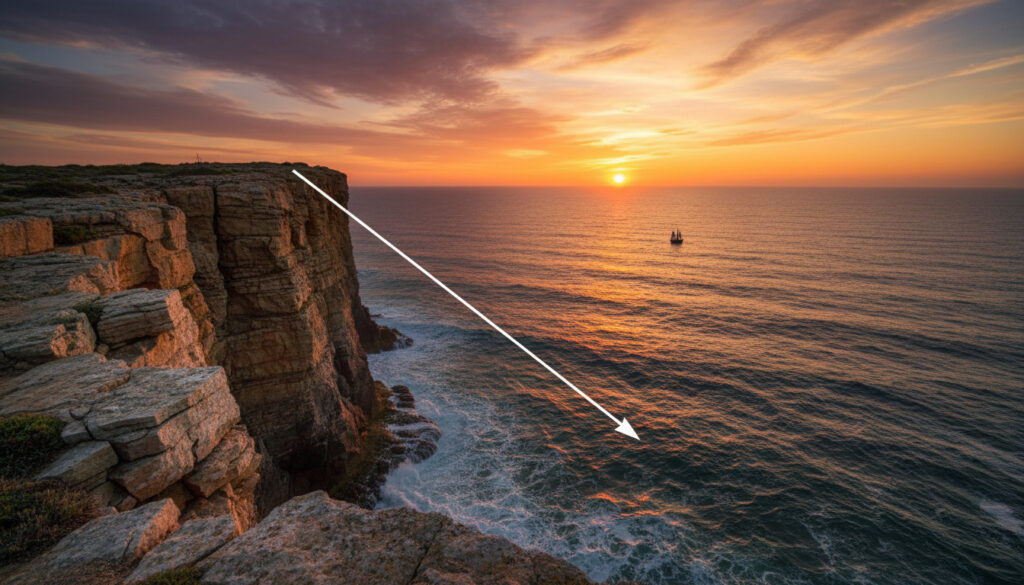
When an individual stands atop a vertical structure and gazes downward toward a distant point, the angle formed describes how far their vision drops below the true horizontal plane. Mathematical definitions emphasize that this measurement originates specifically from the observer’s eye level, not from ground level or the top of the structure.
The concept inherently creates a right triangle configuration, where the observer’s height establishes one leg, the horizontal ground distance forms another, and the direct line of sight becomes the hypotenuse as defined by mathematical educational resources. This geometric framework allows for consistent application of tangent, sine, and cosine ratios depending on which distances remain known or unknown in a given scenario.
What Is the Angle of Depression?
Several fundamental characteristics define this trigonometric measurement and distinguish it from other angular concepts:
- Always measured from the horizontal plane at the observer’s eye level
- Forms a right triangle with observer height and ground distance
- Real-world contexts include cliff measurements, building heights, and aircraft positioning
- The line of sight functions as the hypotenuse in trigonometric calculations
- Mathematically equivalent to the angle of elevation via alternate interior angles
- Requires knowledge of both vertical and horizontal displacement values
- Universal application across surveying, navigation, and structural engineering
| Attribute | Specification |
|---|---|
| Geometric Definition | Angle below horizontal to object |
| Opposite Concept | Angle of elevation |
| Primary Function | Tangent ratio calculation |
| Units of Measurement | Degrees or radians |
| Constructed Shape | Right triangle |
| Hypotenuse Role | Line of sight |
| Measurement Base | Observer eye level |
| Required Data Points | Vertical and horizontal distance |
| Mathematical Property | Alternate interior angle congruence |
| Professional Fields | Aviation, surveying, construction |
Angle of Depression vs. Angle of Elevation
The distinction between these two angular measurements depends entirely on the relative positioning of the observer and the object being viewed according to Byju’s educational materials. When the observer occupies a higher physical position and looks downward, they create an angle of depression. Conversely, when positioned lower and looking upward toward an elevated object, the observer measures an angle of elevation.
Geometric Relationship and Equality
Despite their opposing directional nature, these angles share a precise mathematical relationship when measured between the same two points. The angle of depression and the angle of elevation are congruent, meaning they possess identical degree measurements. This equality emerges because the two horizontal lines (one at each point) remain parallel to each other, while the line of sight acts as a transversal crossing these parallels, creating alternate interior angles of equal magnitude.
Practical Distinctions in Application
While mathematically equal, the practical applications differ significantly based on measurement accessibility. Surveyors typically measure angles of depression from known elevated points such as hilltops or building roofs. Alternatively, angles of elevation prove more measurable when standing at ground level attempting to determine the height of a tower or tree. The choice between measuring one versus the other often depends on which position offers safer access or more precise instrumentation placement.
The angle of depression always equals the angle of elevation when both are measured between the same two points, as they form alternate interior angles between parallel horizontal lines.
How to Calculate the Angle of Depression
Determining the precise angular measurement requires applying trigonometric ratios to the right triangle formed by the observer’s position, the object below, and the horizontal ground plane. GeeksforGeeks outlines a systematic approach to solving these problems using the inverse trigonometric functions.
Primary Tangent Formula
The tangent ratio serves as the most frequently employed calculation method, particularly when the vertical drop and horizontal distance are known quantities. The formula states that the tangent of the angle equals the ratio of the opposite side (vertical distance) to the adjacent side (horizontal distance): tan(θ) = vertical distance / horizontal distance. This relationship allows for direct calculation when both linear measurements are accessible.
Alternative Trigonometric Ratios
When different combinations of distances are available, mathematicians utilize sine or cosine functions. The sine ratio applies when the hypotenuse (line of sight distance) and the opposite side (vertical drop) are known: sin(θ) = opposite / hypotenuse. The cosine ratio functions similarly when the hypotenuse and adjacent side (horizontal distance) are established: cos(θ) = adjacent / hypotenuse.
Step-by-Step Calculation Method
Solving angle of depression problems follows a systematic four-step process. First, carefully observe and record the given measurements, identifying which sides of the implicit right triangle are provided. Second, determine which sides correspond to the perpendicular (vertical), base (horizontal), and hypotenuse (line of sight). Third, select the appropriate trigonometric ratio based on the available data. Finally, apply the corresponding inverse function to isolate the angle: θ = sin⁻¹(p/h), θ = cos⁻¹(b/h), or θ = tan⁻¹(p/b).
Use tangent when vertical and horizontal distances are known; sine when vertical drop and line-of-sight distance are available; cosine when horizontal distance and line-of-sight length are provided.
Always apply the inverse trigonometric function (tan⁻¹, sin⁻¹, or cos⁻¹) to convert the ratio value into the actual angle measurement in degrees or radians.
Real-Life Examples of Angle of Depression
Professional fields rely on angle of depression calculations to solve spatial problems where direct measurement proves impossible or dangerous. Aviation professionals utilize these angles to determine ground distances during descent patterns, while surveyors apply the principles to map terrain elevations and calculate inaccessible heights.
In construction and engineering, workers standing on elevated structures use downward sighting angles to establish distances to ground markers without descending. Similarly, maritime navigation occasionally requires determining distances to objects below deck level or calculating descent angles for equipment deployment.
A practical illustration involves an observer standing 25 meters above ground level viewing an object 500 meters away horizontally. The calculation proceeds as tan(θ) = 25/500, yielding θ = tan⁻¹(0.05), resulting in approximately 2.86 degrees of depression. Such precision enables accurate mapping and positioning without physical tape measurements across dangerous terrain.
Sequential Calculation Process
- Observe and identify all given side measurements within the problem context
- Classify the known values as perpendicular (vertical), base (horizontal), or hypotenuse (line of sight)
- Select the trigonometric ratio (sine, cosine, or tangent) matching the available data pairs
- Apply the appropriate inverse function to derive the final angle measurement
Established Principles and Clarifications
Definitively Established
- Standard trigonometric definition universally accepted in mathematics
- Measurement always originates from horizontal line at eye level
- Right triangle formation is geometrically mandatory
- Equality with angle of elevation proven via parallel line geometry
- Tangent function serves as primary calculation method
Common Clarifications
- Not dependent on observer height alone, but relative height difference
- Distinct from angle of elevation despite mathematical equality
- Requires two distance measurements minimum for calculation
- Independent of the observer’s physical stature (eye level matters)
- Applies to any downward sighting, not merely vertical drops
Mathematical Context and Problem-Solving Framework
The angle of depression emerges from classical trigonometry, a branch of mathematics developed for measuring triangles and angular relationships. This specific application extends the fundamental SOH CAH TOA mnemonic principles into three-dimensional spatial analysis, allowing practitioners to quantify vertical relationships without physical contact.
Within educational frameworks, this concept typically appears alongside HSC Past Papers – Free NESA Downloads 2001-2024 and other standardized testing materials, reflecting its status as essential curriculum content for secondary and tertiary mathematics students.
The methodology intersects with broader surveying techniques and Murray-Darling Basin – Australia’s Vital River System Explained geographical mapping strategies, demonstrating how abstract mathematical principles solve concrete environmental and infrastructural challenges across varied Australian landscapes.
Authority Definitions and Mathematical Sources
The angle of depression is the angle formed between a horizontal line from the observer’s eye and the line of sight downward to an object positioned below the observer.
Study.com Academic Lessons
The angle below horizontal that an observer must look to see an object that is lower than the observer.
MathWords Mathematical Dictionary
The angle of depression occurs when an observer is positioned higher than the object being observed.
Byju’s Educational Platform
Summary of Angular Measurement Principles
The angle of depression provides a reliable trigonometric method for quantifying downward sighting angles from elevated positions, forming essential right triangle relationships that enable distance and height calculations across aviation, surveying, and engineering disciplines. By applying tangent, sine, or cosine ratios to the geometric relationships between observer height, horizontal distance, and line of sight, professionals and students alike can solve spatial problems involving inaccessible measurements. Mastery of this concept, alongside its relationship to angle of elevation, constitutes a fundamental competency in practical mathematics and applied geometry.
Frequently Asked Questions
Why does the angle of depression equal the angle of elevation?
They are alternate interior angles formed by parallel horizontal lines and the transversal line of sight, making them congruent.
Can you calculate angle of depression without knowing the horizontal distance?
Yes, if you know the hypotenuse (line of sight) and vertical distance, use sine; if you know hypotenuse and horizontal distance, use cosine.
Is angle of depression always measured in degrees?
No, it can be measured in either degrees or radians depending on the mathematical context or specific application requirements.
What happens if the observer and object are at the same height?
The angle of depression becomes zero degrees because the line of sight runs exactly parallel to the horizontal reference plane.
Do you need special equipment to measure angle of depression in the field?
Clinometers or theodolites provide precise measurements, though calculated values derived from known distances often suffice for theoretical problems.
Can angle of depression be greater than 90 degrees?
No, by definition it remains between 0 and 90 degrees as it measures deviation from horizontal downward toward an object below.
How does eye level affect the calculation?
All measurements must reference the horizontal line at the observer’s specific eye level, not the ground beneath their feet or the top of their head.
Are angle of depression problems always right triangles?
Yes, the geometric construction inherently creates a right triangle between the vertical drop, horizontal distance, and line of sight.
More related posts
 Steve Howey: Divorce, New Look, and High Potential Role
 Lamar Odom: NBA Champion, Tragedy, and Recovery
 Kentia Palm Care: Complete Guide to Growing and Watering
 Ja Rule: Rise, Fall, Feuds, Prison Sentence & Net Worth
 Benjamin Bratt Ethnicity, Career & Personal Life
 Terrell May: Contract, Brothers, Roosters Exit & 2025 News
 Grace Kim: Age, Nationality, Height & LPGA Career
 Greg Page Wiggles: Why He Left and His Health Story
