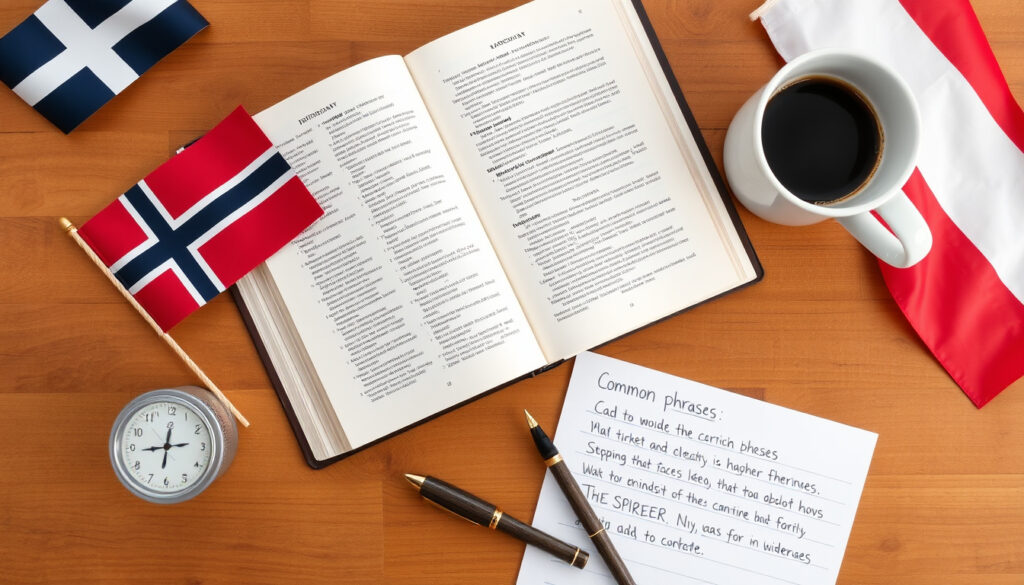
Norwegian to English: Common Phrases and Translation Tips
If you’ve ever tried to figure out what a Norwegian friend means by “går det bra” or why they giggle when you say “hi hi,” you’re not alone. Norwegian is spoken by about 5.3 million people, and while it shares high mutual intelligibility with Danish and Swedish, its phrases carry cultural weight that direct translation often misses.
Norwegian speakers worldwide: 5.3 million ·
Alphabet letters: 29 ·
Language family: North Germanic ·
Mutual intelligibility with Danish and Swedish: High
Quick snapshot
- Exact number of Norwegian dialects is unknown — estimates range from dozens to hundreds (Nordic Visitor)
- Origin of the “hi hi” laughter expression is not well documented, though it appears widely in informal Norwegian text (Nordic Visitor)
- Norwegian is ranked a Category I language for English speakers by the U.S. Foreign Service Institute, meaning it requires about 600–750 class hours to reach professional proficiency (FSI language rankings)
- Use tools like Google Translate, Quillbot, and Cambridge Dictionary for quick translations, but verify cultural context
- Practice with native speakers to master pronunciation and pitch accent (Google Translate)
- Focus on learning prepositions early — they often differ from English usage (Google Translate)
| Attribute | Value |
|---|---|
| Official language | Norway |
| Number of speakers | 5.3 million (Nordic Visitor) |
| Written forms | Bokmål and Nynorsk (Wikipedia) |
| Alphabet | 29 letters (including æ, ø, å) (Nordic Visitor) |
How Do Norwegians Say “I Love You”?
Literal translation vs. cultural usage
- The direct translation is Jeg elsker deg — but Norwegians reserve it for deep romantic love (Wikipedia (Norwegian phrasebook))
- A more common everyday alternative is Jeg er glad i deg («I am fond of you»), used with family and close friends (Nordic Visitor)
- Using Jeg elsker deg too early or too casually can feel overly intense (Fjord Tours)
Learners who default to “I love you” in English risk overshooting the relationship. The safer bet: Jeg er glad i deg until you’re certain the feeling is mutual.
The implication: when translating love phrases, matching the emotional weight matters more than the literal words. For English speakers, the soft alternative is often the right call.
What Does “Går Det Bra” Mean?
Usage as a greeting and response
- Går det bra? literally means “Is it going well?” but it’s used like “How are you?” in casual encounters (Nordic Visitor)
- The standard polite answer is Ja, takk (“Yes, thanks”) — adding takk after ja is considered good manners (Fjord Tours)
- Norwegians often respond with Bare bra («Just fine») as a shorter, equally common variation
If you translate går det bra as a literal health question, you’ll confuse locals. Treat it as a greeting, not an inquiry about well-being.
The pattern: the phrase acts as social lubricant, not information-seeking. For travelers, just echo Ja, takk and you’ll sound natural.
Is Norwegian a Hard Language to Learn?
Comparison to other languages · Grammar and pronunciation challenges
The table below summarizes key factors that determine learning difficulty for English speakers.
| Aspect | Assessment | Source |
|---|---|---|
| FSI difficulty rating for English speakers | Category I (easiest group): ~600 class hours | FSI language rankings |
| Mutual intelligibility | High with written Danish, moderate with spoken Danish and Swedish | Wikipedia |
| Major pronunciation challenge | Pitch accent (tonemes) – can change meaning (e.g., bønder vs. bønner) | Wikipedia |
| Grammar complexity | Simpler than German – no case system, verb conjugation is regular | Nordic Visitor |
For English speakers, Norwegian is one of the more accessible Germanic languages. The catch: mastering the pitch accent requires ear training, but basic communication is reachable quickly.
When to Use “På” in Norwegian?
Common contexts and examples
- På translates to “on”, “at”, or “in” depending on context — unlike English, it’s used with locations: på skolen (at school), på kontoret (at the office) (NorwegianClass101)
- Contrast with i: used for enclosed spaces (i bilen – in the car) and til: used for direction (til Oslo – to Oslo) (Wikipedia)
- A common error: English speakers say i skolen when they mean “at school” — the correct preposition is på
The trade-off: learning Norwegian prepositions early saves months of bad habits. Drill på vs. i with location flash cards.
What Does “Hi Hi” Mean in Norway?
Difference from English “hi” · Usage in laughter
- Hi hi in Norwegian corresponds to English “hee hee” — it’s the written representation of laughter, not a greeting (Fjord Tours)
- It appears frequently in informal chat and text messages to indicate a giggle or light amusement
- Tourists often confuse it with the English greeting “hi” — a harmless but amusing cultural mix-up
If a Norwegian writes hi hi, they’re laughing at something — not saying hello. Responding with a greeting will cause confusion.
The implication: for learners, understanding laughter signals prevents awkward moments. When you see hi hi, the speaker is amused, not waving.
How to Translate Norwegian to English: A Step-by-Step Guide
- Step 1: Identify the phrase type
Is it a greeting, a question, a love phrase, or street slang? Different categories need different translation strategies. For greetings like går det bra, the cultural function matters more than the literal words (Nordic Visitor). - Step 2: Use a reliable dictionary
Consider these resources:- Cambridge Norwegian–English Dictionary – strong for formal and academic language
- Google Translate – quick but misses cultural nuance; verify with a second source
- NorwegianClass101 – good for travel and everyday contexts
- Step 3: Check the cultural context
When in doubt, add takk after ja or nei – it’s the safest politeness trick (Fjord Tours). - Step 4: Practice with native speakers
Feedback from a Norwegian speaker catches pitch accent and preposition errors that no dictionary can fix. Platforms like NorwegianClass101 offer community practice.
What We Know — and What’s Still Unclear
Confirmed facts
- Norwegian has two official written standards (Wikipedia)
- Pitch accent distinguishes words like bønder (farmers) and bønner (beans) (Wikipedia)
- Mutual intelligibility with Danish is asymmetric: written Danish is easier for Norwegians than spoken Danish (Wikipedia)
- Ha det is the most common informal goodbye (Fjord Tours)
What’s unclear
- Exact number of Norwegian dialects — estimates vary widely (Nordic Visitor)
- Origin of the hi hi laughter expression — no definitive source
Expert Perspectives
Adding takk after ja or nei is polite — ja takk is the equivalent of “yes, please.”
– Nordic Visitor (Norwegian travel guide)
If you need directions, ask for written information — it’s a practical communication strategy for travelers.
– NorwegianClass101 (language learning platform)
For English speakers learning Norwegian, the key isn’t just memorizing vocabulary — it’s understanding when a phrase functions as a greeting, a joke, or a serious statement. The choice is clear: invest time in cultural context and preposition usage, or risk sounding like a textbook that never quite fits the conversation.
Frequently asked questions
What is the 3-6-9 rule in dating?
The 3-6-9 rule is an informal dating guideline sometimes mentioned in Norwegian and Scandinavian lifestyle discussions. It suggests waiting three days after a date before contacting someone, six days before a second date, and nine days before escalating. It’s not a universal Norwegian custom but a trend that appears in online dating advice.
What is the 3 bra rule?
The “3 bra rule” is a humorous Norwegian concept that some women own three specific bras: one everyday, one for special occasions, and one that’s comfortable. It’s not a formal rule but a lighthearted observation about wardrobe habits. The phrase occasionally appears in Norwegian lifestyle content.
How do I use Google Translate for Norwegian?
Enter your Norwegian text on Google Translate and select Norwegian to English. It works well for single words and simple sentences but often misses cultural nuance — always double-check expressions like går det bra or hi hi with a native speaker or a curated guide.
Is Norwegian similar to Danish?
Yes, Norwegian and Danish are very similar in writing. Bokmål (used by 85–90% of Norwegians) was originally based on written Danish. Spoken differences are larger: Norwegian has a more melodic pitch accent while Danish has a softer, throatier sound (Wikipedia).
What are the best Norwegian-English dictionaries?
Top resources include the Cambridge Norwegian–English Dictionary for reliable translations, Ordnett.no for advanced learners, and the free Wiktionary for example sentences and etymology.
How to pronounce Norwegian vowels?
Norwegian has 9 vowel letters but around 20 vowel sounds. Key points: a is pronounced like “ah” in father; e like “eh” in bed; i like “ee” in see; o can be “oo” or “oh” depending on context; u is like “oo” but with rounded lips; y is a front rounded vowel similar to French “u”; æ like “a” in cat; ø like “ur” in hurt; å like “aw” in law. Listen to native samples on NorwegianClass101 or Forvo for accurate audio.
More related posts
 Nicolas Jackson: Stats, Bio, Career & Personal Life
 Red and White Flag – Countries, Designs and Meanings
 Men’s Fashion Trends – Styles Colors and Fits for 2025
 Martin Luther: Biography, 95 Theses, Reformation, Beliefs
 Zim vs NZ 2025: Results, Scores & Head-to-Head
 Danny Dyer: Net Worth, Wife Split, Children, and What He Does Now
 Wentworth Miller: Autism Diagnosis, Coming Out, Controversy
