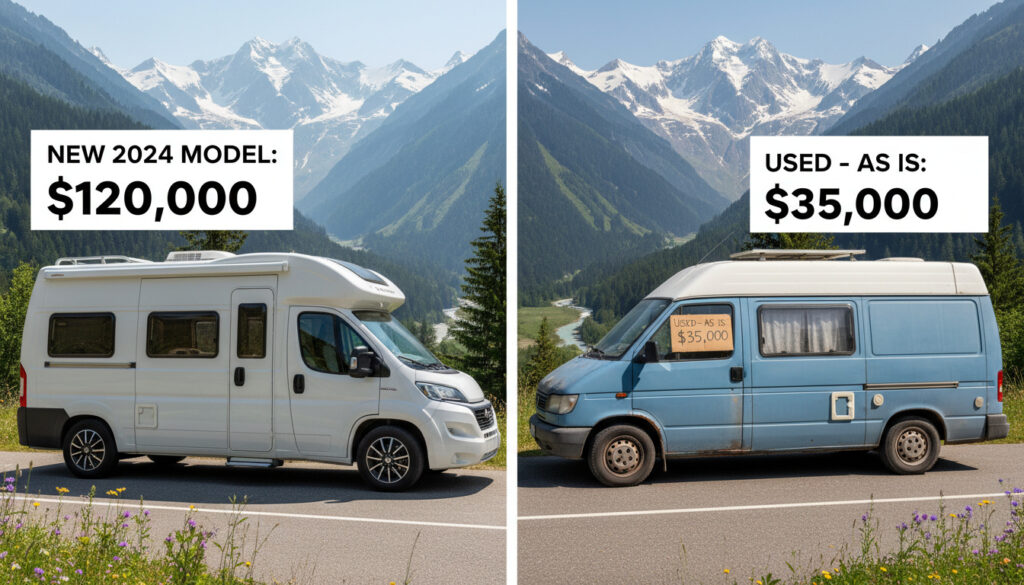
Campervan for Sale – 2024 Prices New vs Used Guide
The campervan market in 2024 presents a diverse landscape for prospective buyers, with new Class B RV conversions starting around $25,000 for basic models and extending beyond $60,000 for premium configurations. Used alternatives offer significant entry points, often dipping below $20,000 for older Volkswagen Transporters or high-mileage Ford Transit conversions, while low-mileage 2019 models maintain values between $40,000 and $45,000.
Understanding the financial and practical distinctions between new and used markets remains essential for buyers navigating this space. New vehicles deliver pristine condition, comprehensive manufacturer warranties, and the latest technological integrations, while used options provide tested mechanical reliability and slower depreciation curves after the initial value drop.
How Much Does a Campervan Cost?
$20,000–$80,000
VW Transporter, Ford Transit
Used saves 40–60%
Mileage & service history
Current market data reveals distinct pricing tiers based on condition and age. 2024 pricing shows basic new conversions starting between $25,000–$30,000, with premium layouts reaching $60,000 or more.
- New basic conversions start between $25,000–$30,000, with premium layouts exceeding $60,000.
- Used entry-level options fall under $20,000 for older VW Transporters or similar platforms.
- Low-mileage 2019 VW Transporter-style units maintain $40,000–$45,000 price points.
- New campervans experience steepest depreciation during years one and two of ownership.
- Used units depreciate slower after the initial drop, offering better value retention.
- Financing rates typically favor new purchases, while insurance costs run higher.
- Maintenance expenses remain lower initially for new vehicles under warranty.
| Factor | New Campervan | Used Campervan |
|---|---|---|
| Average Price | $25,000–$60,000+ | Under $20,000–$45,000 |
| Depreciation | Steep in years 1–2 | Slower after initial drop |
| Condition | Pristine, zero wear | Variable, requires inspection |
| Warranty | Full manufacturer coverage | Often none remaining |
| Technology | Latest features available | Depends on model year |
| Financing Rates | Better rates available | Higher rates possible |
| Insurance Cost | Higher premiums | Typically lower |
| Maintenance | Minimal initially | Potentially higher due to wear |
Where Can I Find Campervans for Sale?
Established dealerships provide structured inventories with verification protocols. Bankston Motor Homes maintains new and used selections with professional inspection standards, reducing buyer risk through documented mechanical histories.
Specialist Platforms and Online Listings
Camperly focuses exclusively on pre-tested used campervans, offering immediate availability without the wait times associated with custom builds. These listings include diverse conversion styles from previous owners, often with “kinks worked out” through real-world use.
Retail Specialists and Regional Dealers
Sunshine State RVs specializes in Class B RVs specifically. Their analysis of New vs. Used Class B RV – What’s Best for You provides category-specific guidance for prospective owners navigating the compact motorhome market.
Zion Motorhomes demonstrates the dealership approach to inventory curation, emphasizing inspection benefits and mechanical verification.
Purchasing through established dealers typically includes professional inspections and disclosure of mechanical history, reducing the risk of hidden defects compared to private sales.
What Should You Look for When Buying a Used Campervan?
Mechanical Inspection and Service Documentation
Buyers should verify complete service records and arrange professional mechanical inspections before purchase. Pre-tested units from reputable platforms have undergone previous real-world use, often resolving initial manufacturing issues.
Conversion Quality and Systems Check
Examine the interior conversion craftsmanship, including electrical systems, plumbing, and insulation. Used campervans offer diverse build qualities depending on whether they were factory conversions or aftermarket projects.
Warranty Transfer and Remaining Coverage
Most used units lack remaining manufacturer warranties, though some low-mileage 2019+ models may retain partial coverage. This absence of protection elevates the importance of thorough pre-purchase evaluation.
Used campervans carry elevated risk of concealed water damage, frame rust, or electrical faults without warranty protection. Professional inspection remains essential before finalizing any used purchase.
What Are the Best Campervans to Buy in 2024?
Budget Options Under $30,000
Forest River and Keystone models adapted to campervan configurations offer accessible entry points for first-time buyers. These units typically appear in used listings under the $30,000 threshold, providing cost-effective introductions to mobile living.
Mid-Range and Premium Selections ($30,000–$60,000+)
Jayco and Forest River manufacture dedicated campervan and toy hauler configurations in this bracket. Volkswagen Transporter conversions from 2019 onward command $40,000–$45,000 with amenities including hot water systems, compressor refrigerators, and integrated heating.
Professional Builds vs. DIY Conversions
The market includes both factory-built units and professionally converted vans. New vs Used Camper Vans provides detailed comparisons of build quality considerations and long-term reliability factors.
New campervans generally qualify for superior financing rates through dealerships, while used purchases may require alternative funding sources or carry higher interest rates due to age and condition risk assessments.
How Have Campervan Prices Evolved Recently?
- : Baseline pricing established for Class B RVs, with standard conversions averaging $25,000–$40,000.
- : “Van life” trend acceleration increases demand for compact, mobile living solutions.
- : Supply chain constraints drive new unit premiums higher, pushing buyers toward used markets.
- : Market stabilization begins as conversion specialists increase production capacity.
- : Current pricing settles at $25,000–$30,000 for basic new conversions and $60,000+ for premium models, with used values holding steady for low-mileage units.
What Factors Create Price Uncertainty in the Campervan Market?
Established Information
- New VW and premium conversions command $60,000+
- Depreciation follows predictable curves: steep initially, then stabilizing
- 2019 models with low mileage hold $40,000–$45,000
- New units include comprehensive manufacturer warranties
Remaining Uncertainties
- Specific Ford Transit conversion pricing remains unverified in current data
- Long-term maintenance costs vary widely by conversion quality
- Future depreciation rates for post-2020 models remain undefined
- Exact insurance premium differentials between specific models lack documentation
What Is Driving Current Campervan Demand?
The surge in campervan interest reflects broader shifts toward mobile lifestyles and flexible travel accommodations. Buyers increasingly prioritize vehicles that function as both transportation and lodging, eliminating the need for separate hotel bookings.
Economic factors also influence purchasing patterns. As traditional vacation costs rise, the one-time investment in a campervan offers perceived long-term savings for frequent travelers. This demand sustains price resilience in the used market, particularly for low-mileage units manufactured between 2019 and 2023.
What Do Industry Specialists Recommend?
New campervans suit heavy or full-time use and buyers seeking comprehensive warranty protection, while used options better serve budgets under $60,000 and first-time owners conducting trial runs.
— Industry analysis from Bankston Motor Homes and Sunshine State RVs
Professional inspection remains critical for used purchases to identify hidden damage and mechanical wear, while new buyers benefit from pristine condition and the latest technological integrations.
— Guidelines from Classic Vans and Camperly
What Is the Bottom Line for Campervan Buyers?
Prospective owners should align purchases with intended usage frequency and budget constraints. Heavy users benefit from new units with warranty coverage, while budget-conscious buyers or lifestyle experimenters find value in depreciation-optimized used models. Regardless of choice, verification of mechanical condition and conversion quality remains paramount. For detailed Class B specific guidance, consult New vs. Used Class B RV – What’s Best for You.
Frequently Asked Questions
How do you finance a campervan purchase?
New campervans typically qualify for better financing rates through dealerships, while used purchases may require higher-interest loans or alternative funding. Banks and specialized RV lenders offer terms varying by vehicle age and borrower credit.
Are campervans a good investment?
Campervans generally depreciate, though used models after the initial two-year drop retain value better. They function as lifestyle investments rather than financial ones, offering travel cost savings rather than appreciation.
What is the optimal age for a used campervan?
2019 models currently offer strong value, priced between $40,000–$45,000 with modern features and manageable wear. Units older than this may require more maintenance but provide entry points under $20,000.
Can you live full-time in a used campervan?
Full-time living demands rigorous mechanical reliability; new or gently used units under warranty provide greater security for constant occupancy. Used units require comprehensive pre-purchase inspection to ensure systems withstand daily use.
Do campervans include bathroom facilities?
Configuration varies by model and conversion. Basic conversions may lack integrated bathrooms, while premium Class B RVs include compact wet baths. Verify specific amenities in individual listings.
Where can you find listings under $20,000?
Older Volkswagen Transporters and high-mileage Ford Transit conversions appear in this price range through specialized platforms and dealer used inventories, though condition varies significantly by maintenance history.
More related posts
 Kaley Cuoco: Age, Net Worth, Family, and Big Bang Theory Facts
 Mahalia Barnes: Biography, Current Projects, and Family
 Andy Byron: Astronomer CEO Resigns After Coldplay Incident
 Time in Paris – CEST Clock, DST and Conversions
 Whoopi Goldberg: Health Scare, Biography & Career Facts
 Lara Bingle: Her Rise, Relationships, and Life Today
 Vivienne Westwood: Biography, Brand, Controversies & FAQs
