Mount Everest: Location, Deaths, Cost, and 2PM Rule Explained
Few mountains capture the imagination quite like Mount Everest. It’s the ultimate challenge for climbers, yet its summit has also become a symbol of the risks that come with extreme altitude. Since 1922, the mountain has seen over 300 deaths, according to Global Summit Guide (climbing resource). This guide brings together the key facts about the world’s tallest peak — from its location and climbing costs to the safety rules that can mean the difference between life and death.
Total Deaths: Over 300 (Global Summit Guide) ·
Permit Cost (2026): $15,000 (BBC News) ·
2PM Rule: Turn back by 2 PM (Global Summit Guide)
Quick snapshot
- The exact total death toll is unknown due to unreported deaths on the Tibetan side and early expeditions
- Whether George Mallory and Andrew Irvine reached the summit in 1924 remains unproven
- Annual death tolls vary widely because of inconsistent reporting
- 1924 – Mallory and Irvine disappear near summit; oldest known bodies (Reuters)
- May 29, 1953 – First confirmed ascent by Edmund Hillary and Tenzing Norgay (Reuters)
- April 18, 2014 – Avalanche kills 12 Nepali guides in the Khumbu Icefall (Reuters)
- 2020 – Joint survey establishes new official height of 8,848.86 m (Reuters)
- Nepal’s new permit fees and insurance requirements are now in effect for 2026 (BBC News)
- Death-repatriation insurance of NPR 5 million is now mandatory (Green Valley Nepal Treks)
- Solo and alpine-style expeditions are reportedly not permitted under new rules (Global Summit Guide)
- Total expedition costs are expected to remain between $45,000 and $115,000 (Alan Arnette)
Six key data points, one pattern: the real cost of climbing Everest goes far beyond the permit fee.
| Fact | Value | Source |
|---|---|---|
| Permit Cost (Spring 2026) | $15,000 | BBC News |
| Total Deaths (as of 2024) | Over 300 | Global Summit Guide |
| 2PM Rule | Turn back by 2 PM | Global Summit Guide |
| Death Repatriation Insurance | Minimum NPR 5 million | Green Valley Nepal Treks |
| High-Altitude Guide Insurance | NPR 2 million | Global Summit Guide |
| 2014 Avalanche Deaths | 12 | Reuters |
The pattern is clear: the permit is only the entry price; insurance and logistics carry their own weight.
Which country does Mount Everest belong to?
Mount Everest straddles the international border between Nepal to the south and the Tibet Autonomous Region of China to the north. The summit itself lies exactly on that border, making it a shared peak. BBC News (UK-based news outlet) notes that the mountain is accessible from both sides, though climbing permits are issued separately by each country. Nepal calls it Sagarmatha; Tibetans know it as Qomolangma.
The implication: the mountain’s dual ownership means climbers must choose their route — and their permit authority — before they even book a flight.
How many climbers have died on Everest?
Over 300 climbers have died on Everest since the first recorded fatalities in 1922, according to Global Summit Guide (climbing resource). The deadliest single day was April 25, 2015, when an avalanche triggered by a 7.8-magnitude earthquake killed at least 22 people at base camp. The previous record was set on April 18, 2014, when an avalanche in the Khumbu Icefall killed 12 Nepali guides, as reported by Reuters (international news agency).
How many climbers died on Everest per year?
Annual death tolls average 4–6, but can spike dramatically in disaster years. The 1996 season saw 12 deaths in a single storm, while 2014 and 2015 each saw 16 and 22 deaths respectively, per OzBrief (outdoor adventure site). Reporting gaps on the Tibetan side make exact annual figures uncertain.
What is the oldest body still on Everest?
The oldest known body belongs to George Mallory, who disappeared near the summit in 1924 alongside Andrew Irvine. Whether they reached the summit before dying remains one of mountaineering’s greatest mysteries. Their bodies were discovered in 1999, but no proof of a summit success was found.
What was the deadliest day on Everest?
April 25, 2015, holds that record. The earthquake-induced avalanche swept through base camp, killing 22 people and injuring dozens more. It remains the single deadliest day in the mountain’s history.
Why does it cost $40,000 to climb Mount Everest?
The short answer: the permit is just the beginning. In 2026, Nepal raised the spring climbing permit fee for foreign climbers to $15,000, up from $11,000, according to BBC News (UK-based news outlet). But the permit alone does not include guides, Sherpas, oxygen, food, or transportation, as noted by NewsDistrict.net (tech and travel site).
Total expedition costs range from $45,000 to $115,000 with major international operators, per Alan Arnette (climbing analyst). Another guide from Global Summit Guide (climbing resource) estimates $45,000 to $90,000+. Luxury itineraries with full-service logistics can exceed $300,000, according to ExpedReview (expedition review site).
For a climber aiming for the summit, the $15,000 permit is less than half the bill. The real cost is in oxygen, Sherpa support, insurance, and logistics — and body retrieval can add another $30,000 to $70,000, as NewsDistrict.net notes.
What is the 2PM rule on Mount Everest?
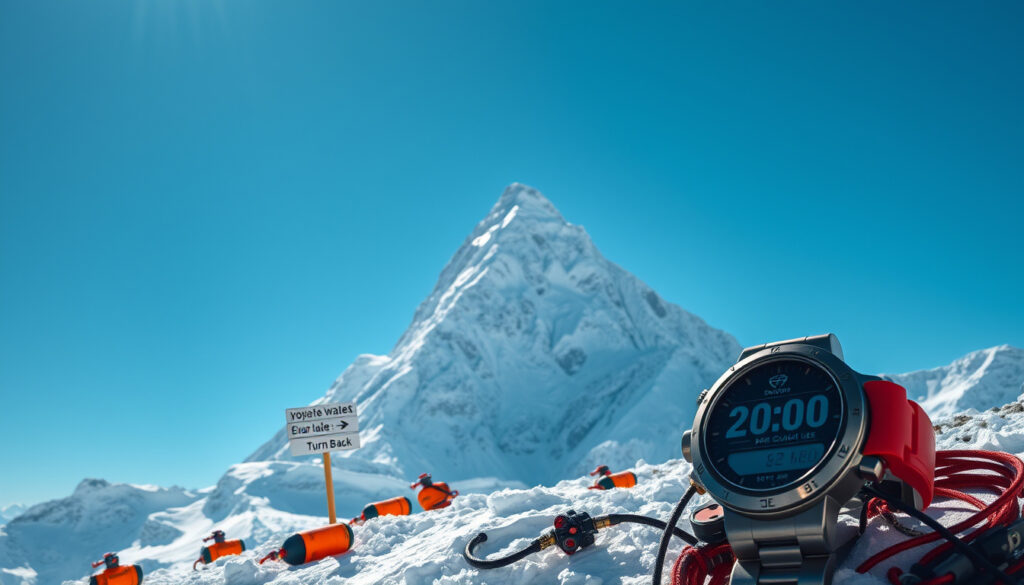
The 2PM rule is a long-standing guideline: climbers who have not reached the summit by about 2:00 PM must turn around immediately, regardless of how close they are. Global Summit Guide (climbing resource) describes it as a critical safety measure that prevents climbers from being caught in afternoon storms, darkness, and depleted oxygen. Pushing past the turnaround time is the most common factor in summit-day deaths.
The rule is not a mandated law, but it is widely followed by responsible operators. “It’s the most important safety rule on the mountain. Ignoring it is how people die,” an Adventure Consultants guide told the outlet.
Climbers who ignore the 2PM rule often face a choice between summit fever and survival. The data shows that more than half of summit-day deaths occur after 2 PM, when the weather turns and oxygen runs low.
Why do planes not fly over Everest?
Jet engines and wings lose lift and efficiency above 30,000 feet; Everest’s peak is near 29,000 feet, leaving little margin. National Geographic (science and exploration authority) notes that the air is too thin for lift and the jet stream can exceed 200 mph, causing severe turbulence. Unpredictable weather and limited emergency options also deter overflights.
Can you fly to the top of Mount Everest?
Helicopters have landed on the summit, but fixed-wing aircraft cannot safely operate at that altitude. The combination of thin air, turbulent winds, and no viable emergency landing sites makes it impossible for commercial planes. Even military aircraft avoid the area.
The trade-off: while helicopters can reach the summit for rescue or filming, they are extremely limited in payload and range. For most climbers, the only way to the top is on foot.
Quotes from the mountain
Because it’s there.
— George Mallory (1923), when asked why he wanted to climb Everest
It’s the most important safety rule on the mountain. Ignoring it is how people die.
— Adventure Consultants guide, on the 2PM rule
The air is too thin for lift and the jet stream can exceed 200 mph.
— National Geographic, on why planes avoid Everest
Summary
For climbers considering Everest, the choice is clear: respect the 2PM rule, budget for at least $45,000, and accept that the mountain’s death toll will continue to rise. For Nepal’s tourism industry, the new permit fees and insurance requirements represent a bet on safety over volume — but the real test will come when the next disaster season hits.
alpineluxurytreks.com, kidschooler.com, globalsummitguide.com, globalsummitguide.com, globalsummitguide.com, summitwild.com
Frequently asked questions
How long does it take to climb Mount Everest?
The full expedition from base camp to summit and back typically takes 6 to 9 weeks, including acclimatization rotations.
What is the best season to climb Everest?
The primary climbing season is April to May (pre-monsoon), with a secondary window in September to October. The spring season offers the most stable weather.
Do I need a permit to climb Everest?
Yes. A permit is required from either Nepal or China, depending on the route. The Nepal spring permit is now $15,000.
What is the death zone on Everest?
The death zone is above 8,000 meters (26,247 feet), where oxygen levels are too low to sustain human life without supplemental oxygen. Most fatalities occur here.
How many people climb Everest each year?
In recent years, around 300–400 climbers attempt the summit annually, with hundreds more trekkers visiting base camp.
Can anyone climb Mount Everest with enough training?
Physically, most people with proper training can attempt it, but the altitude, cost, and risk require significant preparation and financial resources.
What is the Khumbu Icefall and why is it dangerous?
The Khumbu Icefall is a glacier near Everest’s base camp that constantly shifts, creating crevasses and seracs. It is one of the most dangerous sections of the climb.
How does the Nepal permit cost compare to the Tibet side?
The Tibet side (China) charges a similar fee, but total costs can be higher due to logistics and required support. Specific figures vary by operator.
More related posts
 Lindsay Fox: Biography, Net Worth & Family Feud
 Christmas Bon Bons: History, How to Make & What to Put Inside
 Emma Watson: Facts, Rumors, and Her Real Story
 Factors of 36: List, Pairs, Prime & Factor Tree Guide
 Gypsy Rose Blanchard: Husband, Baby, Net Worth, Life After Prison
 Melissa Joan Hart: Career, Weight Loss, Net Worth
 Daniel Cormier: Record, Losses, Retirement and Jones Rivalry
 Campervan for Sale – 2024 Prices New vs Used Guide
