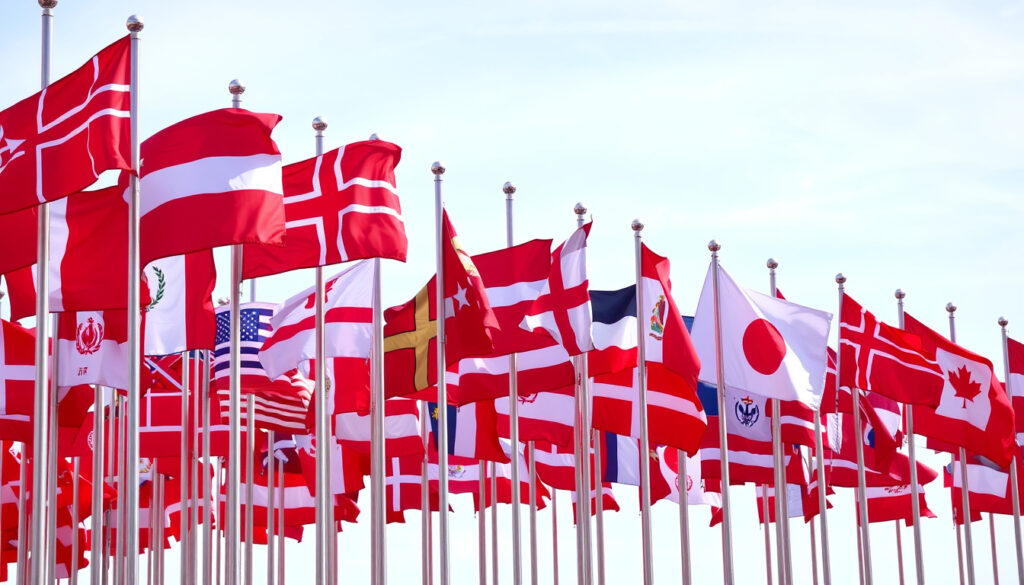
Red and White Flag – Countries, Designs and Meanings
Introduction, Which Countries Have Red and White Flags, Key Insights, Quick Reference, Strictly Red and White Flags, Symbolism, Timeline, Key Facts, Sources, Summary, Frequently Asked Questions
Over 20 nations worldwide incorporate red and white color combinations into their national flags, each design carrying distinct historical origins and symbolic weight. These flags range from simple two-stripe banners to complex emblems featuring crosses, crescents, and national symbols. The common thread binding these diverse nations together lies in the powerful meanings attributed to red and white—colors that have represented courage, sacrifice, peace, and purity across centuries of heraldic tradition.
Understanding which countries use red and white flags requires examining both the visual designs and the cultural contexts that gave rise to them. Some nations adopted their red and white banners centuries ago, while others finalized their designs within living memory. This comprehensive guide provides an overview of red and white national flags, their meanings, and the historical moments that shaped their creation.
Which Countries Have Red and White Flags?
Several dozen countries incorporate red and white into their national banners, making this color combination among the most prevalent in vexillology. The following overview highlights the most recognizable examples and their distinctive designs.
Features a red maple leaf centered on a white field flanked by two red borders. The design emphasizes natural beauty and national unity.
Two horizontal stripes with white on top and red below. Known as the Biało-Czerwona, this simple design dates to the early 15th century.
A bicolor flag with red on top and white on bottom. The Sang Saka Merah-Putih has roots extending to the Majapahit Empire of the late 1200s.
Nearly identical to Indonesia’s flag—red over white bicolor—adopted in 1881 and tied to the House of Grimaldi since at least 1339.
Key Insights on Countries with Red and White Flags
- Red universally represents courage, blood shed for independence, sacrifice, and sometimes the earth or Mother Earth
- White commonly symbolizes peace, purity, honesty, sincerity, and aspirations for harmony
- The red-white-red horizontal triband pattern (like Austria’s) is among the oldest flag designs in Europe
- Several flags share nearly identical red-and-white bicolor patterns despite being adopted centuries apart
- Nordic countries frequently use white crosses on red fields, with Denmark’s Dannebrog inspiring Finland, Iceland, Norway, and Sweden
- Vertical tribands with white centers and red edges appear in flags of Peru and other South American nations
- Some nations add emblems to distinguish their flags from similar designs—Singapore’s crescent and stars set it apart from Monaco and Indonesia
Quick Reference: Red and White Flag Designs
| Country | Design | Adopted | Distinctive Feature |
|---|---|---|---|
| Austria | Red-white-red horizontal triband | May 1, 1918 | Origins trace to 1191 under Duke Leopold V |
| Canada | Red borders with white center and maple leaf | February 15, 1965 | Maple leaf symbolizes natural strength |
| Denmark | Red field with white Nordic cross | 1219 | Oldest national flag still in use |
| Indonesia | Red over white bicolor | 1950 | Colors date to late 1200s Majapahit Empire |
| Latvia | Crimson and cream horizontal bicolor | 1920 | Reflects Latvian Riflemen uniforms from WWI |
| Monaco | Red over white bicolor | 1881 | Colors tied to House of Grimaldi since 1339 |
| Peru | Red-white-red vertical triband | 1825 (modified 1950) | Includes national coat of arms |
| Poland | White over red horizontal bicolor | 1919 | Colors linked to Battle of Grunwald, 1410 |
| Singapore | Red over white with crescent and stars | December 1959 / August 1965 | Emblem distinguishes from Monaco and Indonesia |
What Flags Are Strictly Red and White?
When identifying flags that use only red and white colors, distinctions emerge between pure bicolor designs and those featuring additional elements. This categorization helps clarify which national banners belong to each group.
Pure Red and White Bicolor Flags
Several nations fly flags containing exclusively red and white without additional colors or emblems. These pure bicolor designs represent some of the simplest yet most striking national symbols.
- Indonesia—Red upper half, white lower half. The Sang Saka Merah-Putih has represented Indonesian sovereignty since 1950.
- Monaco—Red upper half, white lower half. Adopted in 1881, this flag bears the colors associated with the Grimaldi family since at least 1339.
- Poland—White upper half, red lower half. The Biało-Czerwona became official following Poland’s independence in 1918.
- Latvia—Crimson upper half, cream white lower half. Officially adopted in 1921 after independence from the Russian Empire.
The similarity between Indonesia and Monaco’s flags demonstrates how different nations arrived at comparable visual solutions. Indonesia’s adoption occurred in 1950, while Monaco’s design dates to 1881—yet both fly nearly identical red-over-white banners.
Flags with Additional Elements
Other red and white flags incorporate symbols, crosses, or other design elements that go beyond simple bicolor patterns. These additions often carry specific national significance.
- Canada—White center panel with red borders containing a centered red maple leaf
- Denmark—Red field with white Nordic cross extending to all edges
- Singapore—Red over white with white crescent moon and five stars in the upper hoist corner
- Austria—Red-white-red triband with no central charge or emblem
- Peru—Vertical red-white-red triband with national coat of arms centered on white
Horizontal bicolor arrangements appear in Poland and Latvia (white over red) versus Indonesia and Monaco (red over white). Vertical arrangements include Peru’s triband with red outer bands. Nordic crosses like Denmark’s extend the cross pattern to all edges, distinguishing them from simple bicolor layouts.
Distinguishing Similar Flags
The most commonly confused red and white flags belong to Monaco, Indonesia, and Singapore. All three feature red over white arrangements, but key differences enable identification.
Monaco and Indonesia share identical red-over-white bicolor designs with no additional symbols. The only method of distinguishing them is knowing which nation you are observing—geographic context provides the answer.
Singapore’s flag resolves this confusion by adding a white crescent moon and five stars in the upper left corner. This emblem makes Singapore immediately distinguishable from its visually similar counterparts.
What Does the Red and White Flag Mean?
The symbolism embedded in red and white flags reflects the values, history, and aspirations of the nations that fly them. While specific meanings vary by country, certain themes appear consistently across multiple national banners.
Symbolic Meaning of Red
Red dominates the symbolism of red and white flags across nearly every culture that employs this color combination.
- Courage and bravery—Red frequently represents the willingness to defend national interests and face adversity
- Sacrifice and blood—Many nations associate red with blood spilled during independence movements and wars of liberation
- Independence struggles—Peru’s red stripes specifically commemorate blood shed for national independence in the 1820s
- Martyrdom—Bahrain’s red represents the blood of martyrs who died in battle defending the nation
- Power and strength—Austria’s historical use of red symbolized the authority of the Babenberg dynasty
Symbolic Meaning of White
White balances the intensity of red, providing contrasting symbolism that together creates comprehensive national narratives.
- Peace—White universally represents aspirations for harmony, both domestically and internationally
- Purity and honesty—The color conveys moral values that nations seek to embody
- Sincerity and truth—Latvia’s white reflects ideals of honesty in public and private life
- Sky and heaven—Some interpretations connect white to celestial aspirations and divine favor
- National aspirations—Poland’s white symbolizes the nation’s dreams for peace and democratic governance
Historical Origins of Color Symbolism
The specific origins of red and white symbolism often derive from legendary events or historical circumstances unique to each nation.
Austria’s flag legend attributes the red-white-red pattern to Duke Leopold V, whose tunic allegedly became bloodstained during the 1191 Battle of Acre, leaving a white stripe where his belt had been. This colorful origin story symbolizes how the Babenberg dynasty’s military valor gave rise to a lasting national emblem.
Poland’s colors trace to the Battle of Grunwald in 1410, where white and red banners flew above Polish-Lithuanian forces defeating the Teutonic Knights. King Władysław II Jagiełło’s coat of arms featured these same colors, cementing their association with Polish national identity.
Denmark’s Dannebrog legend describes the white cross falling from the sky during the 1219 Battle of Lindanise, providing divine validation for the Danish cause. The white cross thus represents both Christianity and supernatural favor in Danish national mythology.
Despite different historical origins, red and white flags share remarkably consistent symbolism across cultures. Red nearly always represents courage, sacrifice, or struggle, while white consistently symbolizes peace, purity, or divine favor. This convergence suggests deep-seated human associations with these colors that transcend individual national narratives.
Modern Interpretations
Contemporary meanings assigned to red and white flags often layer modern interpretations atop historical foundations.
Canada’s flag, adopted in 1965, represents a deliberate break from British colonial symbols. The red maple leaf replaced the Union Jack and Canadian Red Ensign, establishing a distinctly Canadian identity. The colors red and white were borrowed from Canada’s French and British heritage, symbolizing unity between these founding populations.
Singapore’s 1959 adoption of its red and white flag represented the city-state’s emergence as a self-governing territory within the British Empire. The crescent moon and five stars—borrowed from Islamic tradition—acknowledge Singapore’s Muslim majority while the red and white bicolor maintains visual simplicity.
Timeline: Key Adoption Dates for Red and White Flags
The evolution of red and white national flags spans nearly eight centuries, with different nations establishing their designs at various points in history.
- 1219—Denmark’s Dannebrog first appeared during the Battle of Lindanise, making it one of the oldest continuously used national flags
- 1410—Poland’s white and red colors gained prominence following the Battle of Grunwald victory over the Teutonic Knights
- 1339—Colors associated with Monaco’s ruling House of Grimaldi established in heraldic records
- Late 1200s—Red and white adopted as banner colors of Indonesia’s Majapahit Empire
- 1881—Monaco officially adopted its red-over-white flag design
- 1875—Tonga adopted its flag featuring a red cross on white with blue borders
- 1825—Peru adopted its vertical red-white-red triband, modified in 1950 with the national coat of arms
- 1920—Latvia officially adopted its crimson and cream flag after independence from the Russian Empire
- May 1, 1918—Austria’s red-white-red flag officially adopted following the empire’s dissolution
- 1919—Poland’s Biało-Czerwona became the official national flag with the restoration of independence
- December 1959—Singapore adopted its red and white flag with crescent and stars as a self-governing territory
- February 15, 1965—Canada’s current maple leaf flag officially adopted, replacing the colonial-era ensigns
- August 1965—Singapore reaffirmed its flag design upon full independence from Malaysia
Key Facts and Common Questions
Certain aspects of red and white flags remain well-established in historical records, while other details involve varying interpretations or incomplete documentation.
| Established Information | Ambiguous or Interpretive Areas |
|---|---|
| Denmark’s Dannebrog is among the oldest national flags still in use, dating to 1219 | Whether Austria’s legend of Duke Leopold V’s bloodstained tunic is historically accurate remains debated |
| Indonesia and Monaco fly nearly identical red-over-white bicolor flags | The precise original shade of red used in historical flags is often uncertain due to textile fading |
| Poland’s white-over-red design became official in 1919 | Some historians dispute whether the 1410 Battle of Grunwald directly inspired the flag colors |
| Singapore added crescent and stars specifically to distinguish its flag from Monaco and Indonesia | The meaning of Singapore’s crescent and five stars involves multiple scholarly interpretations |
| Canada adopted its maple leaf design in 1965 | The degree to which white represents French heritage versus universal peace remains interpretive |
Sources and Expert Perspectives
The study of red and white flags draws from multiple disciplines, including history, vexillology, art history, and cultural anthropology. The following sources provide foundation for understanding these national symbols.
“Over 20 flags worldwide incorporate red and white color combinations, each with distinct historical origins and symbolic significance.”
— Vexillology research compiled from multiple historical sources
“Red commonly represents courage, blood shed for independence, and sacrifice, while white symbolizes peace, purity, and honesty.”
— Historical analysis of color symbolism in national banners
“The Dannebrog’s distinctive Nordic cross design inspired several other flags, including those of Finland, Iceland, Norway, and Sweden.”
— Cross-cultural influence in flag design studies
Summary
Red and white flags represent one of the most widespread color combinations in vexillology, adopted by over 20 nations across every inhabited continent. These designs range from Austria’s ancient red-white-red triband to Singapore’s distinctive crescent-and-stars emblem. The consistent symbolism—red for courage, sacrifice, and struggle; white for peace, purity, and honesty—reflects universal human values that transcend individual cultural contexts. Whether flying pure bicolors like Poland’s simple banner or complex emblems like England’s flag, nations that choose red and white communicate their historical narratives through colors that have represented power, resistance, and aspiration for centuries. For readers seeking to identify or understand specific red and white flags, focusing on arrangement patterns (horizontal versus vertical), additional symbols (crosses, crescents, stars), and historical context provides reliable methods for accurate identification.
Frequently Asked Questions
Is the Canadian flag red and white?
Yes, Canada’s flag features red borders on both sides with a white center panel containing a single red maple leaf. The design was officially adopted on February 15, 1965, replacing previous colonial-era flags.
What is the difference between Monaco’s flag and Indonesia’s flag?
Visually, the two flags are nearly identical—both feature red on top and white on bottom. The only reliable method of distinguishing them is geographic context, as Monaco is a European microstate and Indonesia is a Southeast Asian archipelago. The two nations adopted their flags centuries apart.
Which countries have the oldest red and white flags?
Denmark’s Dannebrog, dating to 1219, is among the oldest national flags still in continuous use. Austria’s red-white-red pattern traces to 1191 according to legend. Indonesia’s red and white colors extend to the late 1200s Majapahit Empire.
What does white represent on the Polish flag?
On Poland’s Biało-Czerwona, white symbolizes peace, purity, and the nation’s aspirations for these values. This interpretation connects to Poland’s historical struggles for independence and democratic governance.
Why does Singapore’s flag look similar to Monaco and Indonesia?
Singapore’s flag deliberately echoes Monaco and Indonesia’s red-over-white bicolor designs. Singapore added its distinctive white crescent moon and five stars in the upper hoist corner specifically to differentiate itself from these similar flags.
Are there red and white flags in Asia beyond Indonesia?
Yes, Singapore flies a red and white flag featuring a crescent and stars. Several other Asian nations incorporate red and white, though often alongside additional colors not fitting a strict bicolor design.
What is the significance of the Nordic cross on red?
Denmark pioneered the Nordic cross design—white crosses extending to all edges of a red field—starting in 1219. This style inspired Sweden, Norway, Finland, and Iceland. The cross traditionally represents Christianity and was associated with divine favor in Scandinavian lore.
More related posts
 Men’s Fashion Trends – Styles Colors and Fits for 2025
 Secrets of the Silent Witch: Episodes, Romance & Season 2
 Darling Downs Radiology: Phone, Bulk Billing & More
 Aimee Garcia: Ethnicity, Net Worth, Age, Movies, and TV Shows
 The Long Walk Movie – Plot, Cast, Book Differences and Release
 Christopher Reeve: Accident, Life After Paralysis, and Family Tragedy
 Dax Shepard: Sobriety, Health, Net Worth, and Family Life
 Moonee Ponds Super Clinic: Services, Walk-Ins & Bulk Billing
